Featured StoryEditor's Pick
Latest Articles
Expert-reviewed articles on personal wellness, medical breakthroughs, nutrition, and the science of living well.
An independent health journalism site sharing evidence-based information in plain language — for curious readers, not patients.
Every article is grounded in peer-reviewed research and guidelines from reputable health authorities.
Our articles are health journalism, not medical advice. They inform conversations with your doctor — they don't replace them.
Each article ends with a "Further Reading" section linking to the studies and authorities behind our claims, so you can verify them yourself.
AliveAndKicking Health is a health journalism site, not a medical service. We share evidence-based information — but information is not the same as medical advice. The articles on this site are intended for general educational purposes only.
Nothing you read here should be used to diagnose a condition, choose a treatment, change a medication, or replace a conversation with a qualified healthcare professional. If you're worried about something specific to your body, please talk to a doctor or other licensed provider — they can do the one thing we cannot, which is examine and treat you.
If you're experiencing a medical emergency, call your local emergency number immediately.
We're a small, independent publication. Our editorial process is straightforward and transparent: every article is written from current peer-reviewed research, guidelines from established health bodies (such as the World Health Organization, national health authorities, and major medical societies), and consensus statements published in respected journals.
To make our work verifiable, every article includes a Further Reading section at the bottom that links directly to the studies and sources we relied on. We believe credibility comes from showing the sources, not from claiming authority. If you ever want to check a claim we make, the source should be one click away.
No. AliveAndKicking Health publishes general health information for an educational, lay audience. Nothing here is intended to diagnose, treat, prevent, or cure any condition. For medical advice tailored to your situation, please speak with a qualified healthcare professional.
Every article includes a "Further Reading" section at the bottom linking to the peer-reviewed studies, official guidelines, or expert sources behind our claims. You don't have to take our word for it — the citations are there for you to verify directly. If you ever find a claim that isn't supported by the source we cite, please tell us via the Contact page and we'll correct it.
AliveAndKicking Health is a small, independently operated publication. We don't claim to have a team of doctors on staff — what we have is a commitment to research and transparent sourcing. Where individual articles benefit from being attributed to a specific author, we'll note it; where they don't, we publish them under our editorial banner.
You should make health decisions in consultation with a qualified healthcare provider who knows your medical history. What our articles can do is help you ask better questions, understand the landscape of a topic, or recognize when something is worth bringing up at your next appointment. Use them as a starting point for conversations, not as a substitute for them.
We publish new articles regularly and revise older ones when significant new research changes the picture. When an article is meaningfully updated, we add a dated note. Health science is a moving target — we try to keep up, but recommend always checking the publication date on any article and considering whether newer evidence may have emerged.
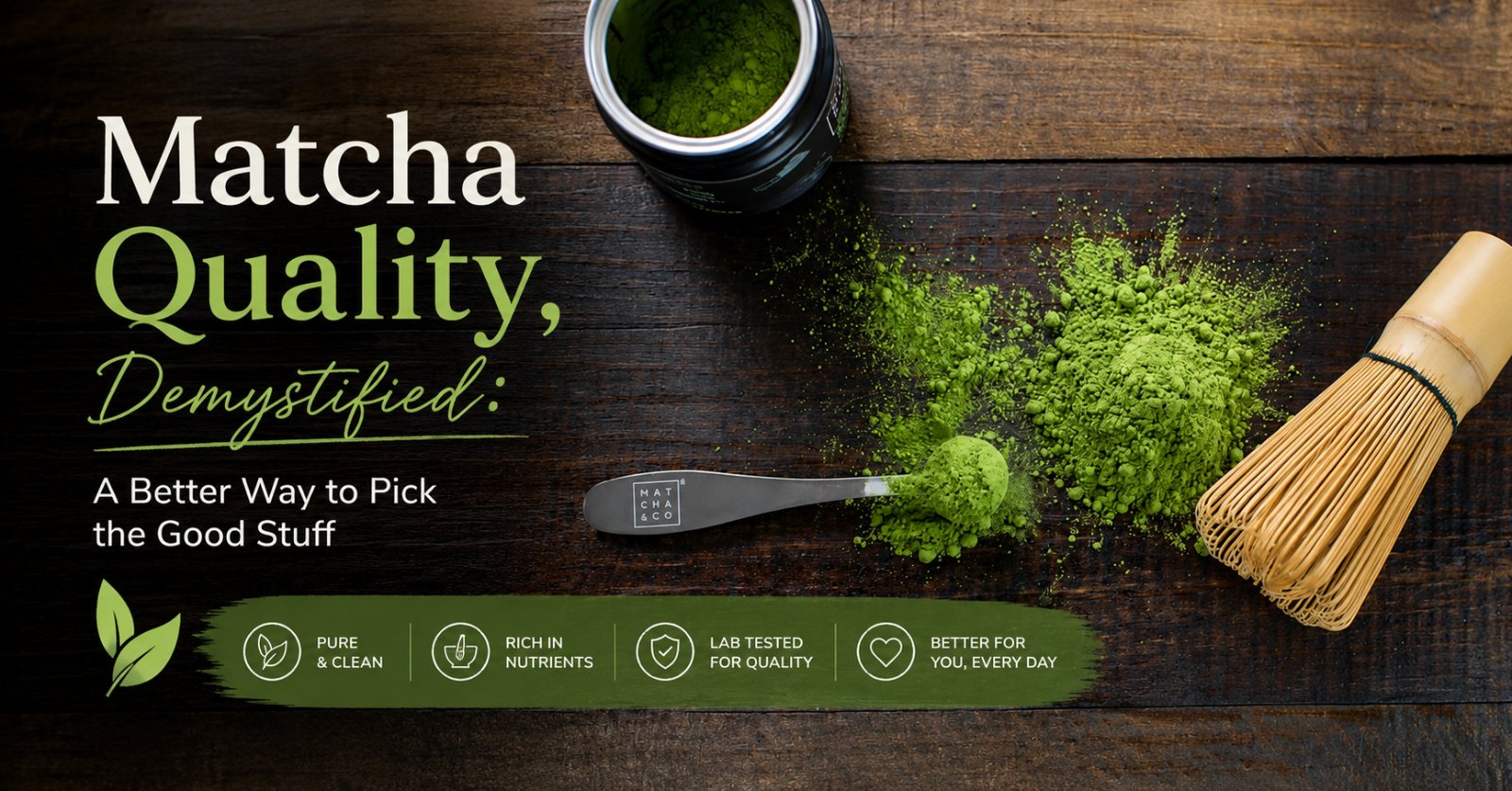
You've seen "ceremonial grade" plastered on every premium matcha tin. Surprise: that label isn't a real Japanese category — it's a marketing term invented for Western buyers. Here's what actually determines whether matcha is good: shading, harvest timing, the leaf itself, where it was grown, and how it was milled. Knowing these four things will help you spend smarter and drink better than any "grade" label ever could.
If you've ever shopped for matcha, you've seen "ceremonial grade" everywhere. The phrase carries an air of authority, suggesting it refers to something formally recognized — perhaps a Japanese standard, or a tea-master endorsement, or a specific type of leaf reserved for traditional tea ceremonies.
It refers to none of those things.
There is no government body, tea association, or industry organization — in Japan or anywhere else — that defines or regulates "ceremonial grade." Multiple Japanese tea producers and importers are explicit about this. The term emerged in the early 2000s when matcha began entering Western health-food and specialty-tea markets, and importers needed a shorthand to distinguish powders meant for drinking on their own from powders meant for cooking and lattes. It was a translation aid, not a quality standard.
Today, with no regulatory authority enforcing the term, any brand can put "ceremonial grade" on any matcha. A cheap powder made from late-harvest leaves can carry the label as easily as a premium first-flush single-cultivar matcha from Uji. Two tins side-by-side on a shelf, both labeled "ceremonial grade," may differ in actual quality by an order of magnitude — and there's nothing in the labeling system to tell you which is which.
This is not a story about a useless category. It's a story about a label that has become detached from the thing it was meant to describe, and a wellness industry happy to charge a premium for that detached label.
In Japan, matcha isn't classified by "grades" with English names. Producers and tea masters evaluate matcha along several specific dimensions, each of which has real effects on flavor, color, and nutrition.
**Shading.** This is the single biggest factor. About three to four weeks before harvest, the tea plants are covered with screens or natural cover that block most of the sunlight. Deprived of full sun, the plant compensates by producing more chlorophyll (which gives high-quality matcha its electric green color) and accumulating more L-theanine, the amino acid responsible for matcha's signature savory-sweet umami flavor. Without shade, the plant converts L-theanine into catechins, the compounds that taste bitter and astringent.
A 2025 peer-reviewed study in Molecules confirmed that shade-growing significantly increases both theanine and chlorophyll while decreasing the catechins responsible for bitterness [1]. Earlier research published in 2022 (Plants, MDPI) found the same effect, with shading rates between 60% and 98% transforming the plant's biochemistry [2]. The catch: proper shading is expensive and labor-intensive. Cheap matcha is rarely shaded for the full duration, or is shaded with less effective methods.
**Harvest timing.** The first harvest of the year (called *ichibancha*, typically late April through mid-May) produces the youngest, most tender leaves at the top of the plant. These leaves contain the highest concentrations of L-theanine and the most delicate aromatic compounds. The second and third harvests yield leaves with progressively lower amino acid content and higher catechin levels — meaning more bitterness and less of matcha's signature sweetness. Excellent matcha is made almost exclusively from first-flush leaves.
**Leaf processing into tencha.** Tencha is the specific dried-leaf form that matcha is ground from. True tencha has its stems and veins removed before drying, leaving only the soft leaf material. Cheaper alternatives sometimes use *sencha rolling* (a different processing technique designed for loose-leaf tea) rather than proper tencha processing — a substitution that's visually similar but produces a different flavor profile. The Yunomi tea industry refers to these as *processing matcha* (加工抹茶) rather than authentic matcha.
**Cultivar.** Different cultivars (subspecies) of *Camellia sinensis* produce different quality matcha. Cultivars like Asahi, Samidori, and Okumidori were bred specifically for tencha production and produce naturally sweeter, more vibrant matcha. Yabukita, the most common Japanese tea cultivar, is widely planted but produces relatively low-quality matcha when used for that purpose.
**Origin region.** The traditional matcha-producing regions — Uji (Kyoto), Nishio (Aichi), and parts of Shizuoka — have soil conditions, climate, and centuries of accumulated expertise that produce reliably high-quality matcha. Matcha from these regions isn't automatically excellent, but the regional baseline tends to be higher.
**Milling.** Authentic premium matcha is ground in slow-rotating stone mills (about 55-60 rotations per minute), which prevents heat buildup that would damage flavor. One small mill produces roughly 40 grams per hour. Cheap matcha is machine-ground at high speed, which is much faster and cheaper but generates heat that degrades the leaf. Some producers cut additional corners by using metal mills.
There's a separate quality consideration that the "ceremonial grade" label completely ignores: where the leaves were grown matters for safety, not just flavor.
Lead and other heavy metals can accumulate in tea leaves through contaminated soil. Because matcha is consumed in its entirety as a powder — not steeped and then discarded like brewable tea — any contamination in the leaf goes directly into your cup. A 2015 analysis by ConsumerLab, an independent third-party testing organization, found that the matcha powders they tested were virtually free of lead, arsenic, cadmium, and pesticide contamination [3], but also noted that this finding does not generalize across all green tea origins. Multiple studies have found significantly higher heavy metal levels in green teas grown in industrial regions of China compared to those grown in Japan and South Korea [3].
This isn't a reason to panic about matcha (the lead exposure from a daily cup of well-sourced Japanese matcha is well below safety thresholds set by the FDA, EFSA, and WHO). It is a reason to care about origin. The "Made in Japan" label — and ideally, a specific region within Japan — does more practical good than "ceremonial grade" ever will.
For extra confidence, some brands publish third-party lab test results showing heavy metal levels. This isn't standard practice, but reputable specialty matcha producers increasingly offer this transparency, and it's a real signal of quality.
Forget the grade. Here's what to look for instead:
**Origin.** The label should clearly state Japan as the country of origin, and ideally name a specific region (Uji, Nishio, Shizuoka, Kagoshima). Avoid powders that simply say "Asian" or that obscure the origin.
**Color.** Authentic premium matcha is vibrant emerald green — almost glowing. Yellowish, olive, or brownish powder indicates either oxidation, sun-exposed leaves, or both, and signals lower quality regardless of what the label claims.
**Aroma.** Open the tin and smell it. Good matcha has a fresh, sweet, vegetal aroma. If it smells stale, grassy in an unpleasant way, or like nothing at all, the powder is degraded.
**Texture.** Rub a small amount between your fingers. Premium matcha has the texture of fine talcum powder. Gritty or sandy texture indicates coarse grinding (often a sign of machine milling).
**Taste in plain hot water.** This is the real test. Whisk a small amount into hot (not boiling) water and drink it without sweetener or milk. Good matcha is sweet, savory, and umami-rich with only a hint of pleasant astringency. Bitter, harsh, or grassy flavors indicate lower quality leaves or improper processing.
**Price.** This is admittedly imperfect — many overpriced products coast on the "ceremonial grade" label without the substance behind it — but properly produced first-flush, single-cultivar, stone-ground matcha from a quality Japanese region cannot be made cheaply. If a 30-gram tin costs less than about $15-20, something is being compromised. That said, very high prices alone don't guarantee quality either.
**Use the label for what it's worth, not more.** When a brand uses "ceremonial grade," treat it as a hint about *intended use* (drink it plain rather than putting it in a smoothie) rather than as a quality guarantee. Within a single trusted brand's product line, the brand's "ceremonial" tier may genuinely differ from their "culinary" tier. Across brands, the term tells you nothing.
If you enjoy matcha and care about quality more than marketing, the rough framework is: buy from a brand that names its specific Japanese growing region and ideally its cultivar, sources from the first spring harvest, uses stone milling, and publishes (or is willing to share on request) third-party heavy metal testing. Several specialty Japanese tea importers now meet all of these criteria. They tend not to use the "ceremonial grade" label at all — or use it as one small data point among many — because they understand that informed customers want specifics, not slogans.
For everyday drinking — lattes, smoothies, baked goods — the rules relax considerably. Matcha used in milk, sweetener, or other flavored preparations doesn't need to be top-shelf, and using premium first-flush matcha in a sugary latte is genuinely wasteful. Mid-grade matcha from a reputable Japanese producer is perfectly suited for these uses and considerably more affordable.
The bigger picture is the one worth holding onto: the wellness industry has a long pattern of inventing official-sounding terminology that doesn't correspond to any real standard. "Ceremonial grade" is one example. Knowing how to read past the marketing — to look at origin, cultivar, harvest, shading, color, and taste — is a skill that applies to far more than just matcha. It applies to the entire landscape of premium-priced wellness products, and it consistently delivers better outcomes than trusting whatever the label happens to claim.
If you'd like to dig deeper into the science of matcha, or have specific health concerns related to caffeine or polyphenols, please talk to a qualified healthcare provider who can give advice tailored to your circumstances.
How AliveAndKicking Health handles your data, in plain language.
AliveAndKicking Health Media ("we", "our", "us") operates this website. If you have questions about this policy or how your data is handled, you can reach us through the contact information on our About page.
You don't need to create an account, subscribe, or give us any personal information to read articles. We don't run comment sections, email capture forms, or user registration for readers.
When you visit the site, our hosting provider (Netlify) logs the following in line with standard internet practice:
These logs are kept by Netlify for a limited period for security and performance purposes. We do not read or analyse these logs ourselves.
We use your browser's localStorage — which functions similarly to cookies — to store a small amount of data locally on your device:
ak_local_articles, ak_local_nextid) — a copy of the articles list, so the site loads quickly and works offline. Strictly necessary for site function.ak_cookie_consent) — records your choice on the cookie banner, so we don't show it repeatedly.This data stays on your device. It is never sent to us or to any third party.
The fonts used on this site (Playfair Display and Source Sans 3) are self-hosted from our own server. No third-party font service receives requests from your browser. Both fonts are licensed under the SIL Open Font License.
If you consent to "Accept all" cookies, this site displays advertisements. Ads uses cookies and similar technologies to serve ads based on your prior visits to this site or other websites.
Our site is hosted on Netlify. Their privacy practices are documented at netlify.com/privacy.
If you are in the European Economic Area, the United Kingdom, or Switzerland, you have the following rights regarding any personal data we hold:
Since we collect almost no personal data directly, most of these rights are satisfied by you simply clearing your browser's site data. For anything else, contact us.
Our content is intended for a general adult audience. We do not knowingly collect data from children under 16. If you believe a child has provided us with data, please contact us and we will take steps to delete it.
You can change your cookie preferences at any time by clicking the button below. This will clear your previous choice and re-show the consent banner.
Browser storage persists until you clear it or withdraw consent. Netlify's server logs are retained according to their policy. We do not maintain separate databases of reader data.
Our hosting provider (Netlify) may process data in jurisdictions outside the EEA, including the United States. Netlify participates in appropriate data transfer frameworks such as the EU-US Data Privacy Framework and uses Standard Contractual Clauses where applicable.
If we update this policy, we will update the "Last updated" date at the top. For significant changes, we may re-show the consent banner.
For any privacy-related questions or to exercise your rights, please reach out via the contact details on our Contact page.
The ground rules for using AliveAndKicking Health.
By accessing and using AliveAndKicking Health ("the Site"), you accept and agree to be bound by these Terms of Use. If you do not agree to these terms, please do not use the Site.
All articles, images, graphics, and other content on this Site are protected by copyright and are the property of AliveAndKicking Health Media unless otherwise noted. You may read and share links to our articles freely. You may not republish, redistribute, or reproduce our content in whole or in substantial part without prior written permission.
AliveAndKicking Health, its authors, editors, and affiliates are not liable for any actions taken based on information found on this Site. Reliance on any information provided here is solely at your own risk.
We strive to provide accurate, up-to-date, and well-researched content. However, medical and health research evolves constantly, and we cannot guarantee that every article reflects the absolute latest consensus. If you spot an error, please let us know via the Contact page.
Our articles may contain links to third-party websites. We do not endorse, control, or take responsibility for the content or practices of these external sites. Visiting them is at your own discretion.
The Site may display advertisements served by Ad networks. We do not endorse the products or services advertised. Advertiser relationships are disclosed in our Privacy Policy.
You agree not to use the Site in any way that:
To the fullest extent permitted by applicable law, AliveAndKicking Health Media and its contributors shall not be liable for any indirect, incidental, special, consequential, or punitive damages arising from your use of or inability to use the Site.
We may update these Terms from time to time. The "Last updated" date at the top indicates the most recent revision. Continued use of the Site after changes constitutes acceptance of the revised Terms.
For questions about these Terms, please reach out via our Contact page.
What this site is — and what it isn't. Plain language about the limits of the information we publish.
If you are experiencing a medical emergency, call your local emergency number or visit the nearest emergency department immediately. Do not use this site to seek help for an urgent or life-threatening situation.
Reading articles on AliveAndKicking Health does not create a doctor-patient, therapist-client, or any other professional relationship between you and the site, its contributors, or anyone associated with it. We are journalists writing about health research, not licensed clinicians providing care. We cannot assess your individual circumstances, examine you, review your medical history, or prescribe anything.
We do our best to provide accurate, well-sourced, and current information. Every article cites peer-reviewed research, official health guidelines, or other primary sources, and we link to those sources at the bottom of each piece so you can verify the underlying evidence.
That said, medical and scientific understanding evolves continuously. New research can change what is considered best practice, sometimes within months. While we aim to update articles as significant new evidence emerges, we cannot guarantee that every article reflects the absolute latest consensus at the moment you read it. When making decisions that affect your health, please verify with a qualified professional and check whether more recent research has emerged.
If you spot an error, please contact us — we publish corrections promptly with a dated note.
Our articles link to external sources — peer-reviewed studies, news outlets, health organizations, and similar resources — to allow readers to verify our claims. Linking to a source does not constitute a general endorsement of that source's other content, services, or commercial offerings. We endorse only the specific information cited, in the context cited.
We have no control over external websites and cannot guarantee that linked content remains accurate, available, or unchanged after we publish.
This site may display advertisements served by third-party advertising networks. Advertisements are clearly distinguished from editorial content. We do not endorse or vouch for products or services advertised on the site, and we do not have editorial control over which ads are shown to individual readers.
We do not accept payment in exchange for editorial coverage. Articles are not influenced by advertiser relationships.
Our articles sometimes evaluate commercial products — supplements, diets, devices, treatments, or wellness services — based on the available scientific evidence. These evaluations are editorial opinions grounded in cited research. They are not personal recommendations for you specifically. A product we describe as well-supported by evidence may still be inappropriate for your individual circumstances; a product we describe as overhyped may still have niche legitimate uses. Always discuss specific products with a qualified professional before using them, especially if you have existing health conditions or take medications.
You are responsible for your own health decisions. Information from this site is one input among many that should inform those decisions, alongside guidance from your healthcare providers, your knowledge of your own body, and other reliable sources.
To the fullest extent permitted by applicable law, AliveAndKicking Health Media, its contributors, editors, and affiliates are not liable for any direct, indirect, incidental, consequential, or punitive damages arising from your use of, or reliance on, information published on this site. Reliance on any content is solely at your own risk.
This disclaimer is intended to operate alongside the limitation of liability set out in our Terms of Use, not in place of it.
We may update this disclaimer from time to time as our content, services, or applicable best practices change. The "Last updated" date at the top of this page indicates when the most recent revision was made. We encourage readers to review this page periodically.
If you have questions about anything on this page, please reach out through our Contact page.
How AliveAndKicking Health selects topics, evaluates sources, writes articles, and handles corrections. This is the page that explains how the journalism actually gets made.
AliveAndKicking Health is an independent health journalism site. Our role is to read health and medical research, summarise what it actually shows, and link out to the original sources so readers can verify the claims themselves. Where the evidence is uncertain or contested, we say that. Where the science is settled, we say that too.
We are not a medical publication. None of our editors are practicing clinicians, and we do not provide diagnosis, treatment, or personalized medical advice. Articles on this site are journalism, not medicine — they are intended to inform conversations with qualified healthcare providers, not replace them.
We choose article topics based on three criteria:
We do not select topics based on advertiser preferences, affiliate revenue potential, or sponsor relationships. We have no advertisers or sponsors with editorial influence over which topics we cover.
Every article is built on cited sources. Our preferred source hierarchy, in descending order:
We avoid the following as primary sources: wellness blogs, supplement-industry websites, content farms, self-published health books, anecdotal reports, social media posts, and press releases not backed by published research. Where we reference any of these, we do so explicitly and as the subject of the article, not as evidence supporting a claim.
[1], [2] markers you see throughout each article) are placed after the specific claim each source supports, not at the end of a paragraph as a catch-all.We use AI assistance for parts of the editorial process — including initial research synthesis, draft generation, and copy editing. Every article is reviewed by a human editor before publication, with particular attention to:
We are transparent about this because we think the alternative — using AI tools but pretending otherwise — is the more concerning practice. AI assistance does not change the standard articles must meet before publication; it just changes some of the workflow used to get there.
We treat factual errors seriously. If we publish something inaccurate, we want to know — and we publish corrections promptly.
To request a correction, send an email to contact@aliveandkickinghealth.com or use the Contact form. Include:
Timing. Material errors — factual mistakes, misstated statistics, miscited sources, broken attributions — are reviewed within 2 business days and corrected within 5 business days of confirmation. Minor errors (typos, formatting, broken links) are corrected silently as we find them.
How corrections are shown. For material corrections, we append a dated note at the bottom of the affected article describing what was changed and when. The original error is not silently overwritten — readers should be able to see that an article was updated and why.
If the entire article is wrong. In rare cases where the central premise of an article turns out to be unsupportable, we either issue a substantial revision (with a clear note explaining what changed) or retract the article entirely. Retracted articles are replaced with a page explaining the retraction; the URL is not silently repurposed.
We do not accept payment in exchange for editorial coverage. We do not write sponsored articles, sponsored sections, or "native advertising" disguised as editorial content. We do not allow advertisers, affiliates, or commercial partners to review, shape, or veto editorial content before publication.
Our editorial team does not hold financial positions in companies whose products are evaluated in our articles. Where an editor has a personal connection to a topic that could reasonably be seen as a conflict, they do not write about that topic, or the conflict is disclosed at the top of the article.
We do not accept free products, paid trips, or other benefits from companies in exchange for coverage. Where we evaluate commercial products (supplements, devices, diets, services), the evaluation is based on the published evidence, not on access provided by the manufacturer.
Our articles link to external sources to allow readers to verify our claims directly. Linking to a source does not constitute a general endorsement of that source's other content, commercial offerings, or unrelated views. We endorse only the specific information cited, in the context cited.
We have no control over external websites and cannot guarantee that linked content remains accurate, available, or unchanged after we publish. If a link breaks, please let us know via the Contact page.
We welcome reader feedback, particularly on factual accuracy, source quality, and topics readers think we should cover. Editorial inquiries, corrections, and topic suggestions can be sent to contact@aliveandkickinghealth.com or submitted through the Contact page. We aim to respond within 5 business days.
We may update this editorial policy from time to time as our processes evolve. The "Last updated" date at the top of this page indicates when the most recent revision was made. Significant changes to editorial standards, source policy, or corrections handling will be noted in a brief changelog at the bottom of this page when they occur.
We'd love to hear from you — feedback, corrections, or just a hello.
For editorial inquiries, content corrections, partnership proposals, or general questions, please use the following contact methods:
For inquiries: contact@aliveandkickinghealth.com
We aim to respond to all inquiries within 5 business days.
If you find a factual error in any of our articles, please reach out with:
We review every correction request and publish updates with a dated revision note at the end of the affected article.
We are a small team committed to evidence-based, accurate, and accessible health information. All medical claims are reviewed against peer-reviewed research, guidelines from reputable health authorities, and current clinical consensus. We do not accept payment in exchange for editorial coverage.